
Stop handing agents raw secrets.
Asiri keeps secret values off hosted servers. Agents get a bounded way to use each secret through a local runtime. For critical envelopes, Asiri can require the control plane to ack the audit event before the value is released.
$asiri env --workspace oclan-co --label codex prod/stripe/STRIPE_SECRET_KEY -- ./diagnose-billing
✓ authenticated device · decrypting locally
✓ strict audit ack received · releasing value
audit → label:codex · device:peter-mbp · action:inject · synced
Agents changed the risk model. The old copy-paste habit didn't scale.
Secrets were already spread across .env files, CI settings, servers, and chat. Agents make it worse — they run commands, read files, and can leak credentials into context and logs. Asiri's narrower default: trust the device, grant a named capability, enforce it locally, keep the raw value out of the agent's path.
Managed in one place. Used locally. Audited when it matters.
Encrypted control plane
Ciphertext, wrapped data keys, scope metadata, policies, grants, envelope audit modes, revocation state, and audit records — all in one place. The backend never needs plaintext for the normal runtime path.
Device-bound sync
Each trusted device generates its own keypair locally. It proves possession of the private key before it can unwrap data keys. Private keys never leave the device.
Capabilities, not raw secret access
Authenticated users and service accounts control access. Trusted devices decrypt locally. Agents use injection, mounts, signing, or a local broker without receiving the raw value.
Strict envelope audit
Set production or staging envelopes to strict when administrators need remote visibility before release. The local runtime appends the event, sends it to the control plane, and only materializes the secret after a matching ack.
Your audit trail, in your stack
Send audit events to your OpenTelemetry Collector from Asiri's backend, or push directly from the CLI when the collector is private. Stable event IDs support deduplication, and plaintext secret values stay out of the export.
See audit exportRevocation with reality
Revoke a device and future sync stops immediately. Revocation can't erase what a compromised host already saw — so Asiri is honest that suspected compromise still means upstream rotation.
Hosted coordination. Local plaintext use.
The split is the whole promise. The hosted service coordinates access; a trusted runtime on your own machine performs decryption and the actual moment of use. Customer API traffic never routes through Asiri servers.
See the product model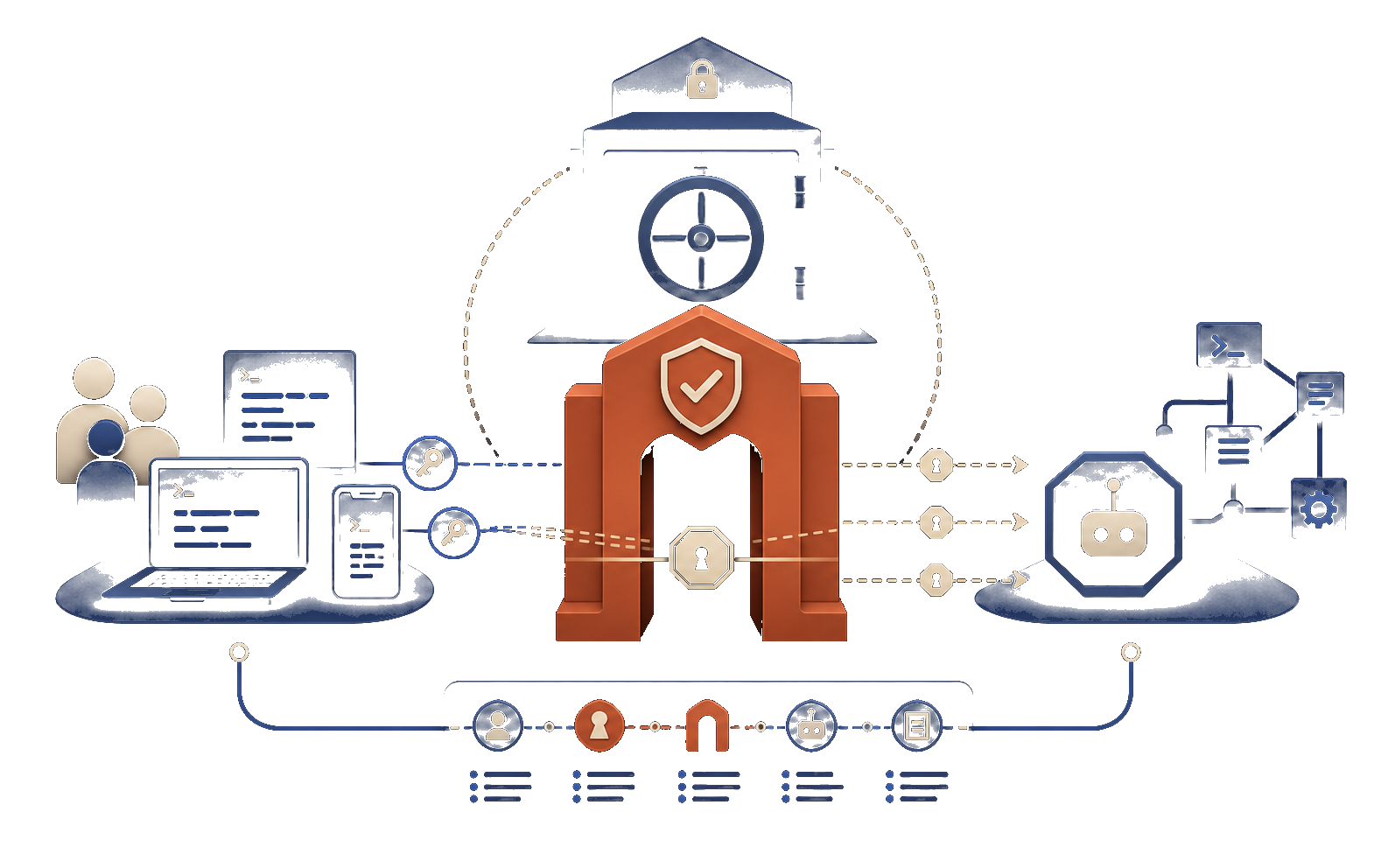
Three commands to the first local use.
The fastest way to understand Asiri is to authenticate on a trusted device, add one secret, and run one command. Add a label only when it makes the audit trail clearer.
-
01
Create the local vault
asiri logincreates or unlocks the local profile. OAuth is only needed when you want the control plane. -
02
Add one secret
asiri add --workspace peter-oclan-co dev/openai/OPENAI_API_KEY --stdinencrypts locally before upload. The control plane stores ciphertext and metadata after push. -
03
Run with an audit label
asiri env --workspace peter-oclan-co --label codex dev/openai/OPENAI_API_KEY -- npm testuses the secret through the trusted local runtime. The label only describes the audit event.
Centrally managed. Locally used. Narrowly granted.
Begin with one development secret and one authenticated workflow on a trusted device. Add CI, containers, and servers once identity, naming, expiry, and audit feel routine.