
Hosted control. Local secret work.
Asiri keeps secret use local. For critical envelopes, strict audit makes the control plane ack the access event before the local runtime releases the value. Buffered envelopes stay useful offline.
Hosted coordination. Local plaintext use.
The hosted service stores encrypted secret versions, wrapped data keys, device public keys, scope metadata, grants, envelope audit modes, revocation state, and audit records. The trusted runtime fetches encrypted bundles, unwraps keys locally, checks policy, and exposes the value only through the approved action.
Customer API traffic stays on your machine or infrastructure. It never routes through Asiri servers.
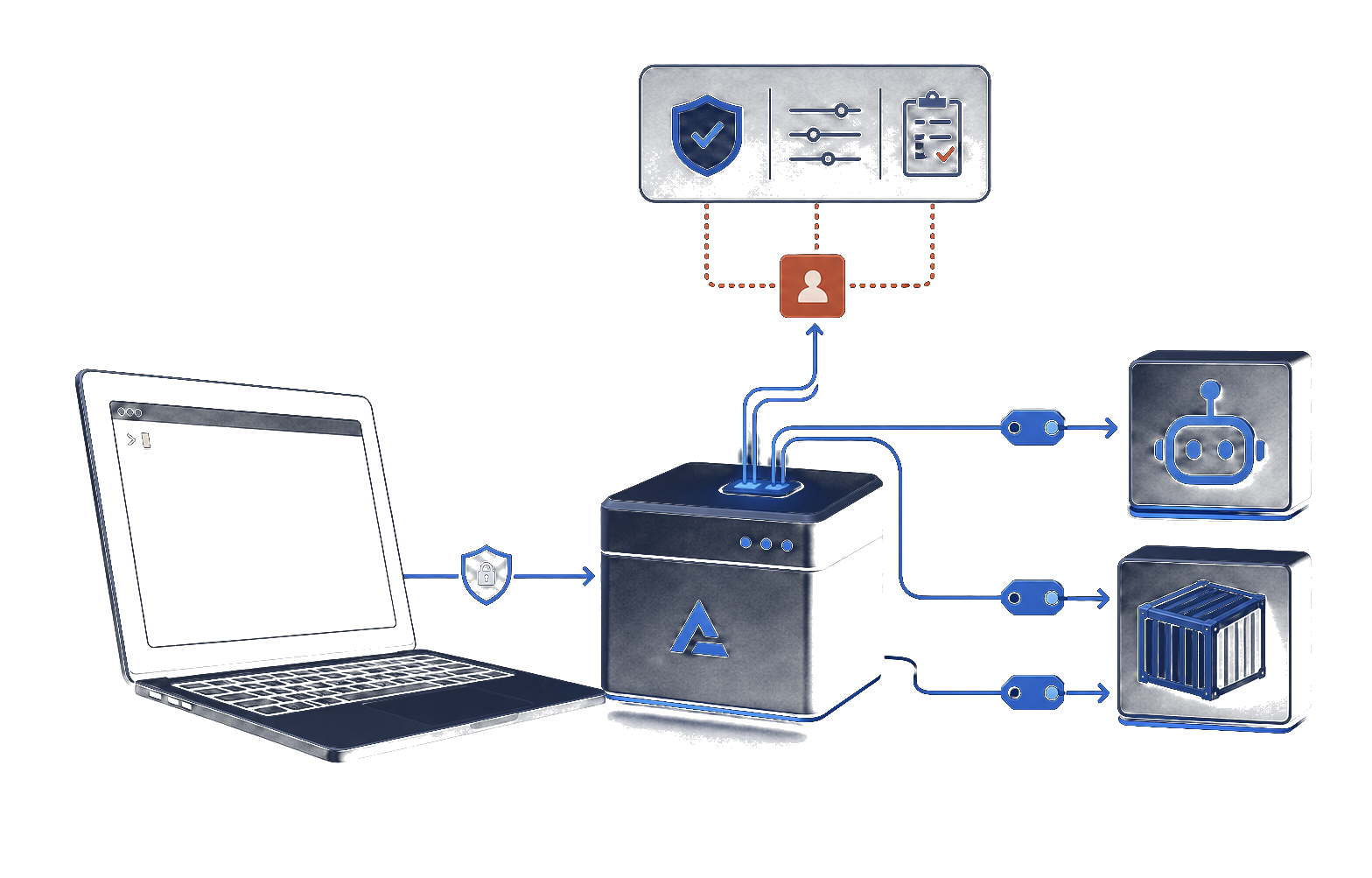
Eight things, no more.
Asiri is a small set of primitives that repeat across every workflow. Once these click, the rest of the product is just configuration.
- Human owner
- Approves identity, devices, policy, and recovery. Agents can prepare setup, but humans anchor trust.
- Trusted device
- A local installation with its own keypair. Private keys stay on the device.
- Envelope
- A lower-case container like
prod/asiriinside an explicit workspace. Sharing an envelope shares only its direct secrets. - Secret
- An uppercase label like
dev/openai/OPENAI_API_KEY, encrypted locally before upload. - Capability
- A scoped action granted to an authenticated user or service account, with trusted-device and audit requirements.
- Audit mode
- An envelope-level setting. Buffered keeps the local workflow useful offline. Strict requires a durable control-plane ack before release.
- Runtime action
- Inject into a command, mount a temporary file, answer a broker request, or run a sidecar.
- Audit trail
- Records who used what, where, how, and why a request was allowed or denied. Values stay out of logs.
Grant the action, then let the local runtime do the sensitive part.
-
01
Name the secretA stable short path like
dev/openai/OPENAI_API_KEYinside a named workspace — a handle humans, machines, and agents can all reference. -
02
Approve the deviceThe human trusts the device and the scope. The private key stays local; the human owns trust and recovery.
-
03
Authorize the identityA signed-in human or narrowly granted service account uses the trusted runtime. A label such as
codexmay describe the audit event but never changes access. -
04
Run locallyThe runtime appends the audit event first. Buffered release continues locally; strict release waits for a matching control-plane ack before the value is exposed.
Local for ordinary work. Acked before release for critical work.
Audit mode belongs to the envelope, so teams can keep local development loose and make production or staging access visible to administrators before release. Child envelopes inherit their parent mode unless a child overrides it.
Strict mode is enforced after a trusted device has synced the policy. It covers Asiri-controlled access paths; a fully compromised trusted host is still outside the guarantee.
Keep the long trail where your security team already works.
Asiri can deliver workspace audit events to your OpenTelemetry Collector with stable event IDs, durable retry, and visible health. Private collector? Push directly from the CLI inside your own network.
Export is at least once and excludes plaintext secret values. Your collector controls downstream routing and retention.
See delivery options✓ OTLP/HTTP protobuf · gzip
✓ last success 12 seconds ago
queued 0 · failures 0 · at least once
retention: Asiri 90d · customer SIEM policy
The quickest proof is one command.
Add one development secret, run a local command as the authenticated identity, and inspect the audit line before expanding usage.